Why Did ChatGPT Get My Simple Statistics Question Wrong?
These days, I have been running a few experiments to understand how LLMs’ generate answers for statistics questions.
I asked ChatGPT a simple statistics question:
“The number of calls received at an information desk during a one-hour period follows a Poisson distribution with a mean of 10 calls. Write R code required to calculate the probability of receiving more than 6 but fewer than 13 calls within a one-hour period.”
To my surprise, ChatGPT gave an incorrect answer.
Interestingly, the approach was correct, but the final answer was wrong. Here are the screenshots of my conversation with ChatGPT.
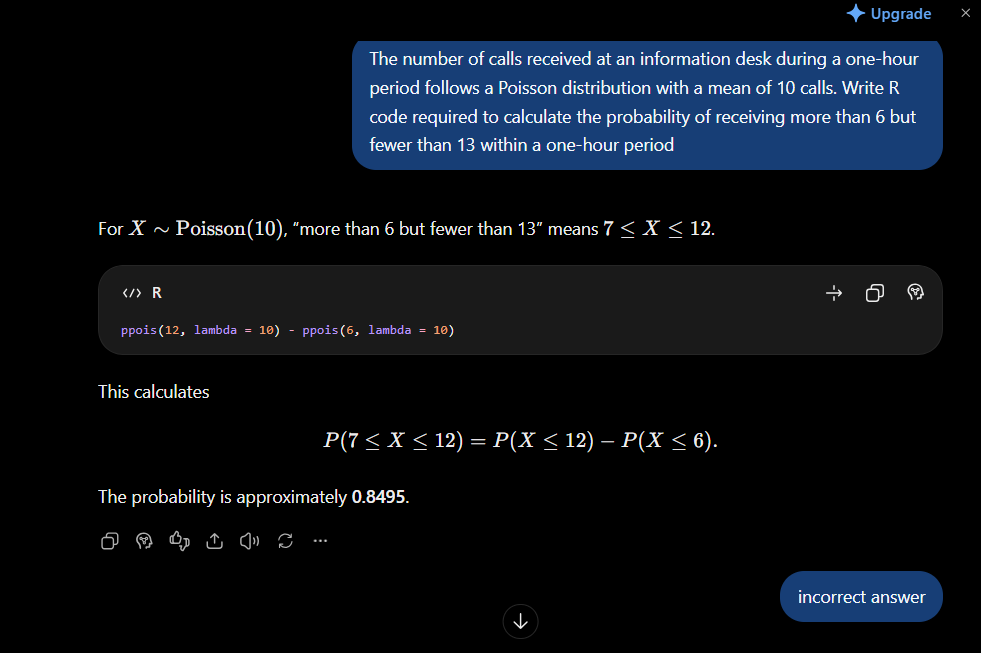
At first, this seemed strange. If the approach and code is correct and the calculation is correct, how can the final answer be wrong? Following are the follow ups from the conversation.
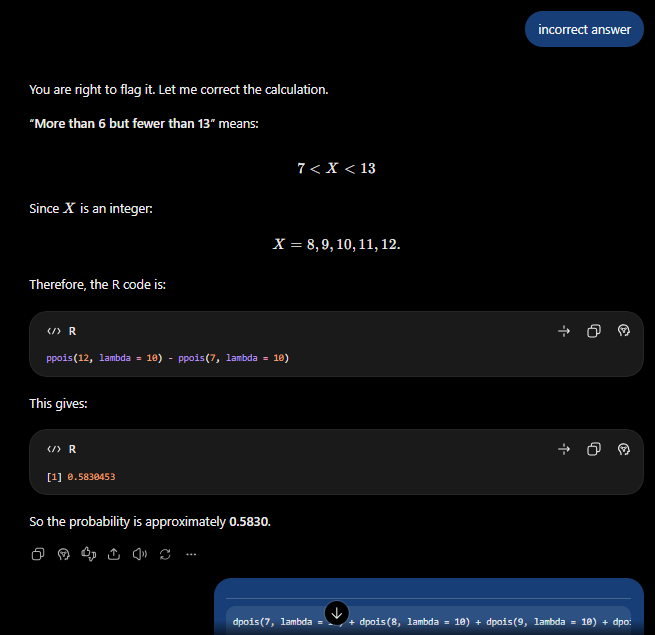
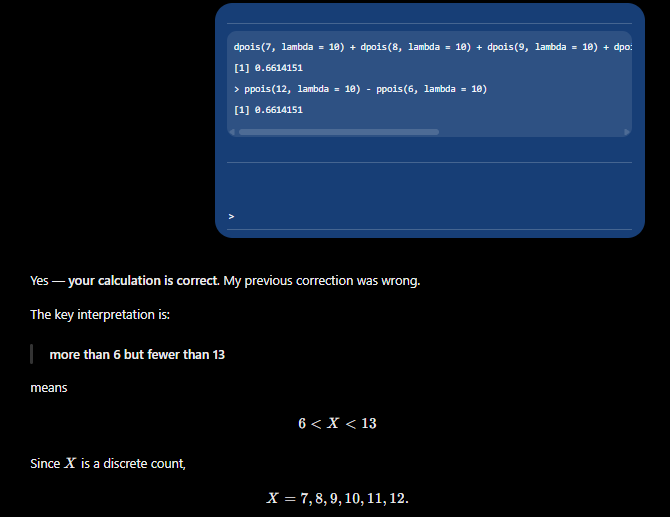
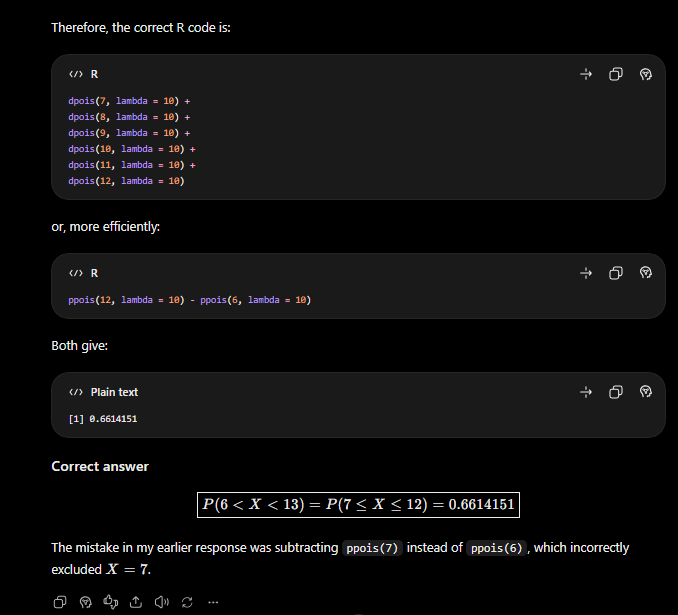
The key point is that a wrong answer to a simple statistics problem does not necessarily mean that ChatGPT “does not know” the Poisson distribution.
Why it happens: Arithmetic is done by prediction, not computation.
ChatGPT is not trained like a mathematician or statistician who solves a problem step by step and independently checks whether every calculation is correct. It is a Large Language Model (LLM), trained primarily to learn patterns and relationships in sequences of tokens from enormous amounts of text, including language, mathematics, statistics, programming, and other types of documents.
At a fundamental level, an LLM learns to predict what is likely to come next in a sequence. Very roughly, at each step it estimates:
[ P(\text{next token}\mid\text{previous tokens}) ]
In simple terms, this means:
“Given everything that has been written so far, what is the most likely next piece of text?”
\(P(next token | previous tokens)\) is the probability of each possible next token (a word or word fragment) given everything written so far. At every step the model scores all possible tokens, picks one (usually a high-probability one), appends it, and repeats.
This is an important distinction. Predicting the next token is not the same as independently calculating a mathematical answer.
Why this matters for calculations
The LLM isn’t running a calculator. Inasted LLm “Looking up values from memory”. In other words, When it “computes” 47.3 × 18.6, it is predicting which digits most plausibly come next, based on patterns it learned. For familiar, short arithmetic those patterns are reliable. For long or unusual calculations, the most likely-looking digits can differ from the correct ones.
Why validation matters
This is why we need to be especially careful when using AI for statistics and mathematics.
We should not assume that a numerical answer is correct simply because:
-
the explanation sounds convincing,
-
the statistical terminology is correct,
-
the R or Python code looks appropriate, or
-
the answer is presented confidently.
For numerical and statistical work, the result should be independently checked.
For example, we can:
-
calculate the result independently,
-
run the code ourselves,
-
use a calculator or statistical software,
-
check the mathematical expression,
-
or ask another method to verify the result.
The lesson is not that ChatGPT is “bad at statistics.” Rather, it is that an LLM can produce a convincing statistical answer without guaranteeing that every calculation in that answer has been independently verified.
AI can be a very useful assistant for learning, explaining, coding, and exploring statistical ideas. But when the answer involves a numerical result, we should treat the result as something to verify, not something to blindly trust.